Nose and Sinus Surgery // Turbinoplasty
Turbinoplasty is surgery aimed at treating nasal turbinate enlargement. Nasal turbinate hypertrophy (enlargement) is usually caused by nasal allergies and is a major cause of nasal congestion. Usually, this can be treated medically. However, when medical management fails, the turbinates can be surgically reduced in size and repositioned to allow for a larger nasal airway. The term turbinoplasty is used because we try to remove as little tissue as possible in reshaping and repositioning the turbinate.
Anatomy: The nasal turbinates are extremely vascular structures inside the nasal cavity. The significant blood flow to these structures allows them to warm air as it enters the nasal cavity. It is also the reason why, when lying down, nasal congestion can increase. Vascular congestion of the turbinates will switch from side to side. Many people, therefore, experience cycling of nasal congestion from one side to the next.
There are three turbinates on each side: the inferior, middle, and superior turbinates. In the illustration below, the turbinates are seen in side view. As you can see, they're quite long and occupy a significant part of the nasal cavity. The CAT scan below demonstrates the turbinates in frontal view. Note that the inferior (lowest) turbinate is the largest and can cause the most amount of obstruction. Therefore, it is the inferior turbinate that is usually the target of medical and surgical management of nasal congestion.

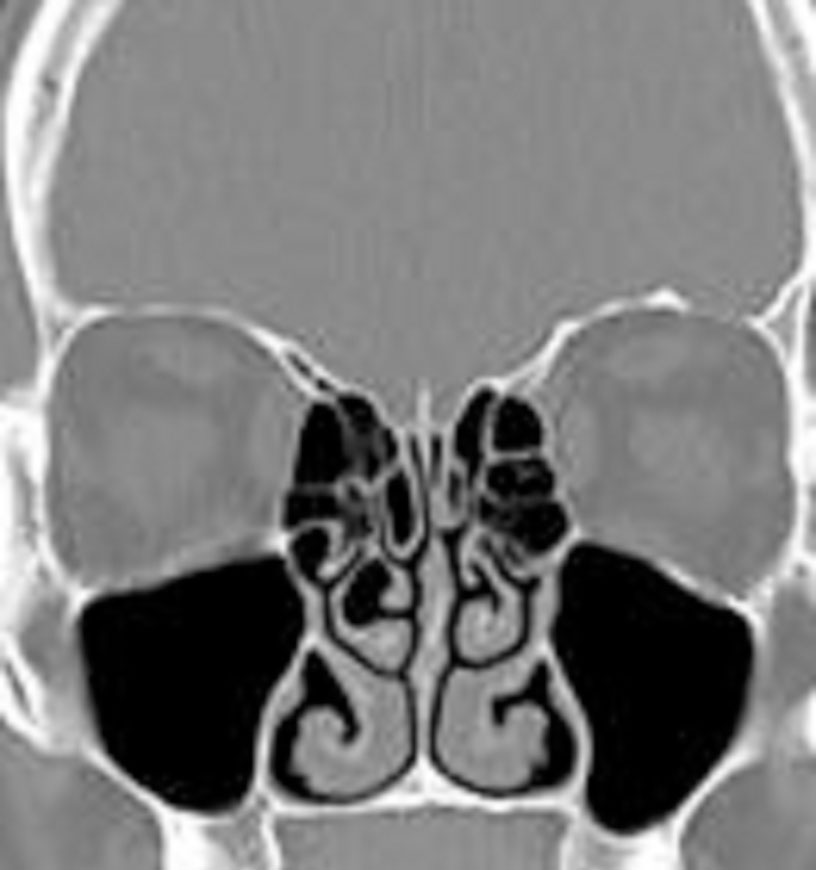
Treatment: As in most conditions, we try to alleviate nasal turbinate hypertrophy and the congestion that it causes with medicine before recommending surgery. Usually, when the turbinate is exposed to particles that an individual is allergic to, the lining thickens and excessive mucous is produced. The most common and effective way of reversing this is with nasal sprays. First, over the counter saline spray can be used to irrigate the nose. If this is done several times per day, exposure to the allergy inducing particles can be minimized and the condition can improve significantly. If this is no enough, medicated spray such as nasal steroids can be added to calm the inflammation and induce medical shrinkage of the turbinate. Note: When using nasal sprays, a common mistake is to aim the bottle in an upward direction along the nasal bridge. As you can see from the diagram and CAT scan, the inferior turbinate is quite low in position, at the level of the nostril and to the side. Therefore, aim you saline or medicated spray to the side and back for maximal effect.
Unfortunately, sometimes medical management is not enough. In such cases, surgery can be considered.
Submucous Turbinate Resection: Like many other types of nasal surgery, the goal is to alter the anatomy while keeping as much normal functioning tissue as possible. Remember that the nasal turbinates have an actual function in keeping the nose moist and in humidifying and warming inspired air. While removing the entire turbinate would be simple and result in a very large nasal airway, this should never be done as it will lead to a very dry nose that always feels congested and abnormal (this condition is called empty nose syndrome and is very difficult to reverse). Modern turbinate surgery depends on removing or shrinking the inner aspect of the turbinate while leaving the external lining (mucosa) alone. This can be done be either delivering thermal energy to the substance of the turbinate to cause it to scar and shrink or by actually sharply removing the deep substance of the turbinate. In either case, the outer lining is left alone to continue its function. In most cases, once the turbinate size is reduced, it can be fractured to the side. This will add even more space to the central nasal cavity while keeping the functional component of the turbinate intact.
|
Dr. K. Amini 8435 Reseda Blvd Northridge, CA 91324 |


@ ENT Doctor LA, Website was created and maintained by Biago Media