Nose and Sinus Surgery // Rhinoplasty
As most people know, rhinoplasty is a procedure designed to change the shape of the nose. What many don't know, however, is that rhinoplasty is not just a cosmetic procedure. In fact, surgeons will commonly recommend rhinoplasty to improve the nasal airway in cases of severe nasal obstruction or deformity.
Whether preformed for cosmetic or functional purposes, rhinoplasty is considered by most surgeons to be the most difficult facial plastic surgical procedure to master. That's because any manipulation of nasal anatomy has the potential consequence of negatively affecting the functions of the nose. Therefore, rhinoplasty demands not only extensive knowledge of nasal anatomy, but also an understanding of how all the bony and soft tissue components interact with each other to allow the nose to function properly. It cannot be viewed as a simple "reduction" procedure and is more complicated than the "nip and tuck" techniques that define other plastic surgery operations.
Unfortunately, many cases of "reduction rhinoplasty" are still performed leaving many people with deformed and nonfunctioning noses. This aggressive removal of bone and cartilage is the main reason that people have progressive difficulty with nasal breathing and obvious surgical deformities years after the procedure. It is also a major indication for revision rhinoplasty, a functional operation that is designed to rebuild the necessary anatomical components of the nose that have been destroyed by previous surgery.
Anatomy: It's important to have a basic understanding of nasal anatomy when considering a rhinoplasty. This will help you become more reasonable in you expectations of the surgery and will also help you ask the appropriate questions when choosing your surgeon.

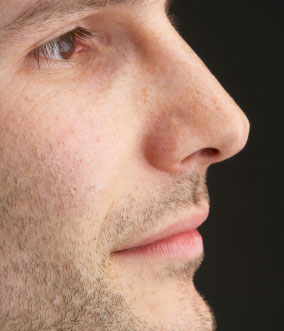
The external nose is composed of mostly skin with minimal amounts of underlying fat and muscle which are draped over a bony and cartilaginous skeletal framework. In the illustration, you can see two types of cartilage that make up the majority of the lower nasal skeleton. They are depicted in a light grey color. These upper and lower lateral cartilages are extremely important in keeping the nasal valve open while air moves through the nose. The upper lateral cartilage is attached to the nasal septum. If its relationship with the nasal septum is not understood, surgical alteration may result in a nasal deformity called an "inverted V deformity". In addition to looking abnormal, it can lead to internal nasal valve collapse and reduce airflow. The lower lateral cartilage (the curved structure that looks like a ram's horn in the picture) helps keeps the nostril area stay open. It is often times aggressively removed during cosmetic rhinoplasty causing an unnaturally pointed nasal tip. This will also lead to collapse of the nostril and external nasal valve which can also reduce nasal airflow. It is therefore understandable that the general concept of the rhinoplasty operation is to change the shape of the nose while maintaining the cartilaginous anatomy illustrated above. In cases if severe nasal deformity, this anatomy will have to be recreated by borrowing cartilage from other parts of the body.
 The pictures to the right are of an individual who desired a smaller appearing nose with less of a "nasal hump" but did not wish any bone or cartilage to be removed. The desired outcome was achieved not by aggressively cutting out important structures, but by reshaping and repositioning the various nasal subunits to achieve the patient's goals.
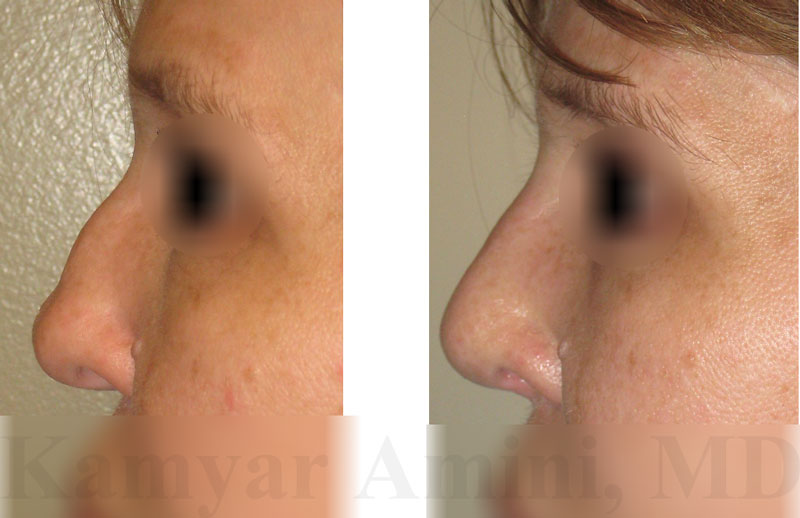
The next example is of a patient with a severe nasal deformity. Such "saddle nose" deformities can be caused by trauma or surgery which removes too much normal bone and cartilage. The repair required grafting cartilage from the ear to replace the structures lost in the nose. Note: Various products are available to augment the nose in such cases. In general, any synthetic material carries a risk of infection for the life of the patient. That means that it can get infected and require removal months or even years after the initial operation. For this reason, it is often preferable to use ones own cartilage and bone in reconstructing the nose. This will add time and complexity to the rhinoplasty case but the effort is worth it.
Finally, you should note that an appropriately performed septoplasty is almost always a part of a good rhinoplasty operation. For a more detailed discussion of septoplasty, please refer to the septoplasty section of this site. For the purposes of the rhinoplasty discussion, just note that septoplasty plays a major role in the majority of these procedures and is often times performed before the external rhinoplasty. One reason is that the septum can be a good source of cartilage that can be used to reshape the nose. Another reason is that any deviations of the septum that are not corrected can lead to even more obstruction once the rhinoplasty is done. Therefore, a septoplasty should always be part of your discussion with the surgeon before proceeding with nasal reconstructive surgery.
|
Dr. K. Amini 8435 Reseda Blvd Northridge, CA 91324 |


@ ENT Doctor LA, Website was created and maintained by Biago Media