Head and Neck Surgery // Larynx
Larynx
Anatomy: The larynx is the medical term for the voice box. In this picture, it is being seen from behind. Many people are surprised by the fact that the main function of the larynx is not speech but, rather, to keep swallowed food and liquid out of the lungs. Every time we swallow, the entire larynx is elevated and the vocal cores come together to shut off access to the airway. This ensures that as the food passes down the throat into the esophagus, none of it gets into the lungs. The second function of the larynx is voice production and phonation. Air passing through closed vocal cords will create a high pitched sound that will travel through the pharynx and oral cavity to produce the deeper voice heard in normal speech.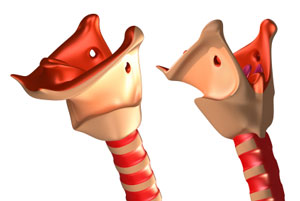
Pathology: Diseases of the larynx can lead to problems with both speech and swallowing. Evaluation will often require an office procedure called a fiberoptic laryngoscopy which allows the otolaryngologist to see all components of the voice box as it moves during speech and swallowing. Several categories of laryngeal pathology will be presented below to provide examples.
Laryngitis: Laryngitis describes a state of inflammation of the larynx. The swollen cords will often lead to hoarseness and, possibly, voice loss. Pain may also be a significant symptom, especially during swallowing.
There are several causes of laryngitis including infections, exposure to irritating chemicals, esophageal reflux, and allergic conditions. Treatment varies on the cause so evaluation by an otolaryngologist-head and neck surgeon is important.
Infectious laryngitis is either viral or bacterial. If this condition is suspected, antibiotics will usually be offered. Obviously, these will only work if the infection is bacterial. Rarely, infectious laryngitis can lead to significant swelling and airway obstruction. If any level of airway obstruction or shortness of breath develop, emergent evaluation and an emergency room visit will be necessary.
Reflux laryngitis results when esophageal reflux disease exposes the larynx to stomach acid. This can occur with or without symptoms of heartburn. Often times, people have hoarseness, throat irritation, and a sensation of something caught in the throat when swallowing. Therapy will include a combination of voice rest, medicine to control reflux, and diet modification. Again, evaluation by an otolaryngologist-head and neck surgeon is important so that laryngeal endoscopy can be performed and more serious conditions such as tumors and paralysis can be ruled out.
Vocal Cord Paralysis: Vocal cord paralysis will usually result in a noticeable voice change. Usually, cord paralysis is a result of surgery in the neck or chest which can damage the recurrent laryngeal nerve. If there is no history of surgery in those areas, then an invasive cancer must be ruled out. Workup will always include fiberoptic laryngoscopy and imaging of the neck and chest with CT or MRI.
If a single cord is paralyzed, the degree of hoarseness will depend on the position that the paralyzed cord is resting at and whether the other (normal) cord can reach it during speech and swallow. If the gap between the cords cannot be closed, there will be significant air escape during speech which will lead to a very weak voice. In severe cases, there may also be aspiration of food or liquid down into the lungs. Fortunately, surgery aimed at augmenting the size and improving the position of a paralyzed vocal cord can help tremendously. Laryngoplasty defines any procedure that aims to change the shape of the larynx. Usually laryngoplasty is used to reposition a paralyzed vocal cord. In new cases of vocal cord paralysis, a vocal cord injection will be offered to bulk up the paralyzed cord so that it abuts the normal cord during speech. This will usually improve symptoms for 3 to 6 months while we wait to see if the paralyzed cord regains its function. If it does not, then a more permanent laryngoplasty will be offered.
Paralysis of both cords is a major problem and, thankfully, very rare. It usually results in a closed voice box which means that breathing will be difficult. Because the vocal cords can't open to allow air in, a tracheotomy will usually be necessary to allow for comfortable breathing until more complicated surgical procedures can be planned to open the airway.
Benign Laryngeal Tumors: Benign laryngeal tumors will cause different symptoms depending on their location. Masses and polyps on the vocal cords will usually lead to voice change and hoarseness. Often times, these result from chronic irritation from either voice abuse or gastric reflux. If medical management fails to eliminate a vocal cord mass, careful microscopic surgical removal will be necessary. In some cases, biopsy will be recommended to make sure the tumor is benign.
Larynx Cancer: Laryngeal cancer is more common in people with significant smoking history. Larynx cancer.may cause similar symptoms to benign laryngeal tumors. Fortunately, when the vocal cords are involved first, hoarseness causes patients to seek help which can lead to an early diagnosis. Any level of hoarseness lasting more than a few weeks should be evaluated by an otolaryngologist-head and neck surgeon to rule out cancer. Treatment of larynx cancer depends on the size, site, and whether it has spread. Small tumors that have not spread can be treated with surgical resection. Modern technology has led to procedures utilizing lasers and robotics to allow for as much tissue sparing as possible. More advanced cases that would require sacrifice of the entire voice box for cure are usually treated with chemotherapy and radiation first. If this does not work, a total laryngectomy will be offered.
|
Dr. K. Amini 8435 Reseda Blvd Northridge, CA 91324 |


@ ENT Doctor LA, Website was created and maintained by Biago Media